The RSS has turned 100, is it? – Devanoora Mahadeva
[ಆರ್ ಎಸ್ ಎಸ್ ಗೆ 100 ವರ್ಷಗಳು ತುಂಬಿದ ಸಂದರ್ಭದಲ್ಲಿ ದೇವನೂರ ಮಹಾದೇವ ಅವರ ಈ ಲೇಖನವು ಫ್ರಂಟ್ ಲೈನ್- ದಿ ಹಿಂದೂ ಪತ್ರಿಕೆಯಲ್ಲಿ 24.9.2025 ರಂದು ಪ್ರಕಟವಾಗಿದೆ. ಈ ಬರಹವನ್ನು ವಿಕಾರ್ ಅಹಮದ್ ಸಯೀದ್ ಅವರು ಇಂಗ್ಲಿಷ್ ಗೆ ಅನುವಾದಿಸಿದ್ದಾರೆ. This article by Devanooru Mahadeva on the occasion of RSS’s 100th anniversary was published in Front Line -The Hindu newspaper on 24.9.2025. This article has been translated into English by Vikar Ahmed Sayeed.]
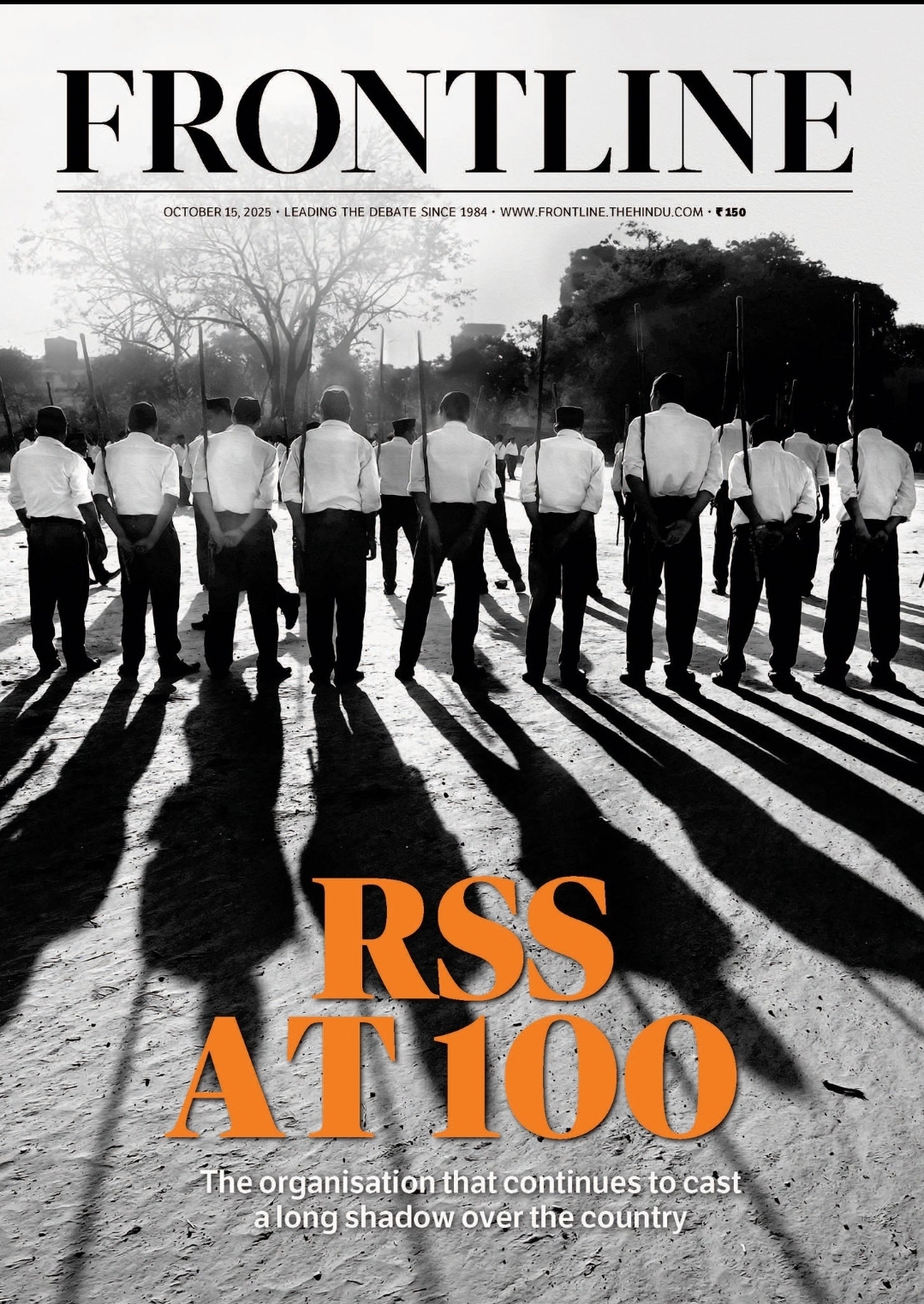
[In its centenary year, the RSS appears to have grownin size and body alone, but not in mind and wisdom-Devanoora Mahadeva]
It has been a hundred years, I believe, since the RSS was born. Today it appears like a gigantic body whose mind stopped growing at an early age. Even those trained in the RSS appear that way. In sheer numbers, the RSS might have grown immensely. But this conveys the imbalance seen in a body grown only in size but not in the mind. It pains me to see my fellow human beings in this state. What is the reason for this stunted condition of the RSS? Where is its root cause? How can the health of my fellow human beings be restored?
The RSS usually chants the words of its sarsanghchalak, Sri M. S. Golwalkar. Let us examine some of them: “If we say that we are part of the organisation and accept its discipline then selectiveness has no place in life. Do what is told. If told to play kabaddi, play kabaddi; told to hold meeting, then meeting…For instance, some of our friends were told to go and work for politics that does not mean that they have great interest or inspiration for it. They don’t die for politics like fish without water. If they are told to withdraw from politics then also there is no objection. Their discretion is just not required.” (Speech of M. S. Golwalkar on March 14, 1954 in Sindi, Wardha) (M.S. Golwalkar, Shri Guruji Samagra Darshan [Collected Works of Golwalkar in Hindi], Bhartiya Vichar Sadhna, Nagpur, Volume 3, page. 32.)
For the RSS, its members do not need to have discretion or be offered an option. What does a man without wisdom, discernment or choice turn into? He will behave like a robot controlled by someone from somewhere else; it is as if he has lost the humanity inside him. Even if those trained in the RSS’ principles live to be a hundred, they may still remain like robots. Even as their bodies grow, their minds may remain stunted as a result of the way the RSS shapes them.
Such people will deny the truth in front of their eyes and come up with arguments aligned with their stunted thoughts. When unable to come up with arguments, they fabricate lies and forge ahead. They keep organising parades to showcase their srength. The RSS proudly projects it as a show of discipline. On the face of it, it appears so. On closer examination, it reveals itself as a training hub for shrievelling the growth of the human personality.
So, what does the RSS want? What end does their cruel truncation of the humanity of human beings strive for? According to Guruji Golwalkar, this is the manifestation of their God: “The first and the most fundamental aspect is the urge for realisation of the Supreme Reality permeating the entire Universe—whatever the name given to it. Or in simple words, it is ‘to realise God’. …We want a ‘living’ God… The Hindu People, they said, is the Virāt Purusha, the Almighty manifesting Himself. Though they did not use the word ‘Hindu’, it is clear from the following description of the Almighty in Purusha Sūkta… Brahmin is the head, King the hands, Vaishya the thighs and Shudra the feet. This means that the people who have this fourfold arrangement, i.e., the Hindu People, is our God.” (M.S. Golwalkar, Bunch of Thoughts, Vikrama Prakashana, Bengaluru, Fourth impression, December 1968, pp. 24-5.)
Hindutva and the chaturvarna system
In other words, establishing the chaturvarna, or the four-fold social order, is to see the living manifestation of their God! In order to make this God manifest, they deploy Rama, Krishna, Shiva, Hanuman and other deities as weapons. We can see this happening in front of our own eyes. In a chaturvarna society, the job of the “arms”, “thighs”, and “feet” is to obey what the “brain” has decided. In the chaturvarna system, therefore, humans considered as the feet, that is, Shudras, are not viewed as people with a brain. The same is true for the “arms” and the “thighs”. This is a system that stuffs their brains with superstitions, customs, rituals and puranic tales and makes them passive and inert.
Savarkar’s writings make clear the real design of those working to establish this order: “Manusmriti is that scripture which is most worshippable after Vedas for our Hindu Nation and which from ancient times has become the basis of our culture-customs, thought and practice. This book for centuries has codified the spiritual and divine march of our nation. Even today the rules which are followed by crores of Hindus in their lives and practices are based on Manusmriti. Today Manusmriti is Hindu Law. That is fundamental.” (V.D. Savarkar, “Women in Manusmriti”, Savarkar Samagra Volume 4 [A collection of Savarkar’s writings in Hindi], Prabhat, Delhi, Volume 4, page 415.)
This means, for the Chaturvarna Hindutva people, Manusmriti itself should become the law. Manusmriti is a legal system of inequality which killed justice through law. Despite this, they want this to become the Constitution. Don’t the words of Golwalkar, Savarkar, stand for debased values, for ideological corruption? Only the intellectually bankrupt can come up with ideas like theirs. What is the fate of women in this scenario? At least the Kshatriyas and Vaishyas have something going in their favour, but what about the plight of the Shudras who were taken to be servants of the upper sections in the past? Worse, the untouchables living outside the villages do not count at all.
We only need to go back a hundred years to Vaikom to get a glimpse of this chaturvarna system. A large Shiva temple can still be seen in Vaikom, a town in the State of Kerala, where Shankaracharya, who professed Advaita, was born. A hundred years ago, the Shudras and untouchables could not only not enter the temple, they could not even walk on the roads along the temple precincts. When a wealthy lawyer, an Ezhava by birth, who was perhaps the only person who owned a car in Vaikom, had to pass these roads in his car, he had to get off and walk on a side road without his feet touching the road around the temple area while his driver, a Nair by birth, drove the car on that road. It was not an exaggeration that Swami Vivekananda, after a tour of Kerala, described the region as a “madhouse”.
In such a wretched situation, the Congress took the lead in organising a satyagraha to let avarnas walk on the roads around the temple. The satyagraha took place with the blessing of Narayana Guru, who practiced Advaita, and the guidance of Mahatma Gandhi. On March 30, 1924, three individuals from different castes—Govinda Panicker, a Nair; Bahuleyan, an Ezhava and Kunjappu, a Pulaya—walked hand in hand towards the road adjacent to the Shiva temple in Vaikom. The satyagrahis agitated daily in this manner but were prevented from marching or were arrested. As the satyagraha began to ebb, Periyar, the fiery opponent of inequality, came to Vaikom responding to the satyagrahis’ requests. His entry lit the flame of satyagraha not just in Kerala but across the Madras Presidency. The 604-day-long satyagraha drew country-wide attention, and awakened communities.
Gandhi at the Vaikom satyagraha
When Gandhiji arrived in Kerala on March 9, 1925, his first words were: “Untouchability and Shudrattva are both terrible practices. I intend to take up these issues with orthodox Hindus.” The very next day, he engaged in a four-hour-long discussion with those who had opposed the Satyagraha such as Indamthuruthil Devan Neelakandan Namboothiri, among others. The conversation unfolded with Gandhi seated on the front verandah, perhaps owing to his overseas travels or his Vaishya background, and the Namboodiri inside the house! Here is a snippet of this conversation taken from Mahadev Desai’s Day-to-Day with Gandhi:
Namboothiri: And why, Mahatmaji, do you use the word “suppressed” for these classes [referring to Shudras and untouchables]? Do you know why they are “suppressed”?
Gandhi: Oh, yes! Just for the same reason that Dyer massacred the innocents in Jallianwala.
Namboothiri: So, you think those who introduced the custom were Dyers? You would call Shankaracharya a Dyer?
Gandhi: I am calling no Acharya a Dyer. But I do characterize your action as Dyerism, and if indeed any Acharya was responsible for introducing this custom his ignorance was as monstrous as that of General Dyer.
Namboothiri: But we did not do this [for the Shudras and Untouchables to remain repressed]
Gandhi: This ignorance is akin to the ignorance of General Dyer.
Namboothiri: There are several Acharyas in the Hindu religion [such as] Madhwacharya, Shankaracharya…We are Shankaracharya’s followers. We accept only what our Acharya says is part of our customs.
(These excerpts are taken from the Kannada translation of Vaikom Horaata, originally a book written in Tamil by P. Athiyaman, and Collected Works of Mahatma Gandhi Volume 26)
In this exchange, the Namboodiri stayed attached to custom, tradition and to his Acharyas. Since the Acharyas made space for the chaturvarna system in their commentaries and refused to impart knowledge to Shudras, we see their later followers themselves crawling as nitya naarakis i.e., eternal sinners, a phrase Madhwacharya used to describe the Shudras. When Shankaracharya, who professed Advaita philosophy, himself says: “All of Manu’s teachings are like a healing medicine,” his Advaita philosophy bites the dust! On the issue of upholding social inequality, the other Acharyas try to outdo one another. What more needs be said? They need to be liberated first.
In the end, the discussion [between Gandhi and Namboothiri] was not successful. Why is it that, throughout the history of Indian civilisation, saints and visionaries are always found among those opposed to the chaturvarna system and the Manusmriti? To put this point more clearly: it is only those who reject the chaturvarna and Manusmriti who become Mahatmas. India’s wisdom and prudence become obvious here. Without such wisdom and prudence, the RSS and its swayamsevaks will remain stunted.
Is it even possible to re-create the chaturvarna order today? Such a question is on the minds of many. We are not able to see what is happening in front of our eyes. What is the policy of Economically Weaker Sections the BJP, a party that dances to the RSS’ tune, brought in? It guarantees ten percent reservation in public education and employment opportunities to the socially, economically and culturally privileged upper castes who are already overrepresented in public institutions and who form only five percent of the Indian population. Isn’t Manudharma’s morality of offering a greater share to the upper castes behind it? Even our judiciary upheld this!
Similarly, in the case of the demolition of the Babri Masjid, if the Supreme Court of India delivered a judgment in accordance with the sentiments of the majority community, didn’t that mean a throwing out of the principles of our legal system? In other words, we are back to an immoral legal system, where justice was not equal but varied from person to person.
Similarly, in 1998, Union Minister Dr Murli Manohar Joshi included a lesson on putrakameshthi yagna (a ritual to be blessed with a male child) in the school syllabus. If astrology replaced scientific astronomy, and priestly customs and Vedic rituals entered school textbooks, one wonders in what age these people live. They are backward-moving people.
The intelligence of those groomed in the RSS will be such that even when they have risen to high ranks, they can declare in a TV interview: “I am not an expert on this matter but, when an airstrike on Pakistan was being considered, the Air Force officers were wondering how to evade the radar. At that point, I said, ‘Strike when the sky is cloudy. That will help escape the radar.’ In the end, this is what they did.” Aren’t these infantile thoughts? It is delightful to hear children say these things, but when elders speak like this, doesn’t it display a lack of judgment? In this climate, happiness has become rare in India.
The Happiness Index ought to blossom in India. Even the RSS needs to join hands to make that happen. Therefore, I pray that it takes my two pleas to heart in its centenary year:
- It is not good culture for the RSS organisation to remain unregistered even after turning a hundred years old, to keep unaudited the funds it has collected from citizens, and to conceal the details of the properties belonging to it. I pray that it rids itself of these blemishes on its centenary occasion at least.
- Ancestors are worshipped in most Indian households. Their favourite dishes are offered to them on this occasion. As part of the worship, we accept the good aspects of the ancestors while exorcising the bad. One can take from this self-renewing attitude and say, “I offer worship to both my biological ancestors as well as my ideological ancestors.” “To unite is divine, to divide is devilish”—surrendering to this wisdom of the Indian subconscious, I absorb the unifying elements from the ancestors and abandon the divisive ones. The RSS needs to adopt this perhaps for the sake of its health. If it could also accept whatever good qualities might exist in its ideological ancestors such as Golwalkar, Savarkar and others, and abandon their divisive and discriminatory thoughts, it has little to lose. That would only be an abandonment of venomous ideas. The poisonous filth found in the self and in society will then get washed away. The imprisoned wisdom, discernment and choices will be set free.
If my prayer is realised, tolerance and love will become abundant in India. That would later usher in respectful coexistence. Decentralised participatory democracy and social justice would then become real. For this reason, the RSS needs to cast off the noose of the teachings of its Gurus, in order to attain wisdom, discernment and agency. Birthday wishes to the RSS that will attain these and find a new birth.
[Devanoora Mahadeva is the co-founder of Dalit Sangarsha Samiti and one of kannada literature’s foremost contemporary writers.]
Translated from Kannada by Vikhar Ahmed Sayeed
ಇತ್ತೀಚಿನ ಪುಟಗಳು
ದೇವನೂರ ಮಹಾದೇವ ಅವರು ಜಾಗೃತ ಕರ್ನಾಟಕ ಸಂಘಟನೆಗೆ ನೀಡಿದ ಅನಿಸಿಕೆ…
ಪೂಜಾರಿಯವರು ಕಟ್ಟಿಸಿದ ಸುಳ್ಳುಗಳ ಗೋಪುರದೊಳಗೆ… -ದೇವನೂರ ಮಹಾದೇವ

“ಆರ್.ಎಸ್.ಎಸ್. ಆಳ-ಅಗಲ” ಕಿರು ಹೊತ್ತಿಗೆಯು ಹಿಂದಿ ಭಾಷೆಗೆ ಅನುವಾದಗೊಂಡಿದೆ…
ಆರ್.ಎಸ್.ಎಸ್.ಗೆ ನೂರು ವರ್ಷಗಳಂತೆ! ಹೌದಾ?-ದೇವನೂರ ಮಹಾದೇವ
The RSS has turned 100, is it? – Devanoora Mahadeva
Between Radical Promise and Despair: Dalit Literature and Movement in Karnataka-ANUPAMA RAO